
Intimacy Coordinators: The times when the director demands nude scenes from actresses are over
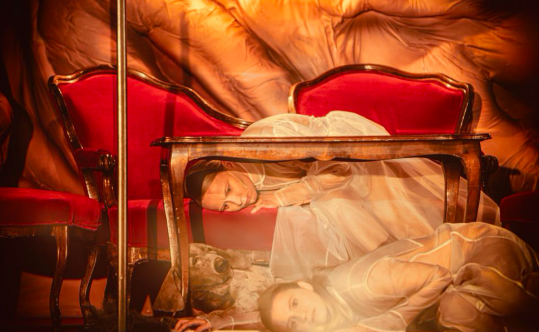
For the first time in Polish theatre – in the play “Immoral Tales” directed by Jakub Skrzywanek at the Powszechny Theatre in Warsaw – intimate scene consultants were hired to work on the show. This is a precedent. What was your role?
Agnieszka Róż: We made sure that scenes showing intimacy, nudity, sexuality or sexual violence were created with the consent of everyone and with respect for the freedom of each person who participated in them. The world of this show is filled to the brim with such scenes. So we tried to make the actors feel safe.
Did they need such protection? They are adults, conscious people – a professional acting team.
AR: That’s right – they are experts. But sometimes we are so used to certain structures that we find it difficult to notice violence. We have become used to the fact that the director has more to say than the others, because it is they who create the world of the show. And yet behind it is the real world of male and female theatre employees who deserve comfortable working conditions. Besides, sometimes it is worth asking the question: when is nudity a really necessary means to achieving the goal intended by the director, and when are actors undressed for another reason... It’s like with the Polish volleyball players’ uniforms. Male players – dressed in loose, comfortable outfits. And female players – in short panties tightening the buttocks and tight t-shirts. The question is, what is it all about? Is it more about sports or more about attracting the gazes of the men who look at these women? With Kuba Skrzywanek, we often looked for an answer to this question, so today I am sure that what the viewers are looking at is important and true, and not shocking and promiscuous.
But doesn’t that mean some form of censorship? After all, art is a space of freedom, exploration, and breaking taboos. Are you not some kind of chaperone? Censor? Controllers who ensure that artists do not cross borders in a sphere in which freedom should reign?
Zhenya Alexandrova: Jakub Skrzywanek told us that when he heard that on the wave of #MeToo, the function of intimacy coordinators was being created in theatres in England – he had real doubts. He feared control and the loss of trust. After Gardzienice and many other situations, he began exploring this topic, finding out what this work is about, and discovered that it is not a control tool, but a mutual support tool that can give a great sense of security to each of the parties. He changed his mind and invited us to cooperate. He understood that it was not about any censorship; it is about drawing attention to the needs of all team members, their capabilities and limits.
AR: When Kuba invited us, he said: “I would like to make a play in which the topic of sexual violence is dealt with. I cannot imagine that I could do this without you because I am a white heterosexual male and despite my best intentions, I can make mistakes that I do not want to make.” He was also anxious not to comment – as a man – on female sexuality and sexual violence against women.
ZA: So we advised, but did not impose anything. We did not say what was allowed and what was not allowed. We did not force actresses and actors in the name of political correctness. It was they who decided whether to undress in a given scene or not; whether they agree to imitation sex or not. We were only helping them figure out where their limits are and how to talk about them. So that the actress could say: “Look, today I’m on my period and my breasts hurt. I don’t want you to touch them.” But if she wanted to play harder that day, undress more – she could.
It is not without reason that we call ourselves consultants, not coordinators, even though the term “intimacy coordinator” functions in English. We do not want to associate ourselves with someone who has a superior, controlling, but only equal – consultative role.
AR: I know that actors are tired of being forced into acts of exhaustion, real excitement, crossing personal boundaries in order to make a given role clearer. That it is not they who decide what they do with their bodies.
Most people will say: “It’s an actor, an actress. The body is the tool of their work.”
ZA: The fact that the body is a tool of their work does not mean that they have to accept everything. In recent years, the #MeToo wave has revealed more abuses in art institutions; also in theatres and theatre academies. When we were working on the show, we talked about it a lot; actors shared their own experiences with us.
Well, for decades the conviction that the end justifies the means was alive in the theatre. So what if the actor is uncomfortable; the art they create is important. Violence was experienced more often by women. When an actress did not want to undress, she was immediately considered “difficult” by the environment.
ZA: And when she undressed, she got the label of a scandalist and a sinner, as in the case of Grażyna Długołęcka – who played the role of Ewa Pobratyńska. For Kuba, the production was inspired by Żeromski’s “The Story of Sin” and a 1975 film based on this novel by Borowczyk. It was one of the highest-grossing films of the Polish People’s Republic; everyone wanted to see it, everyone liked it. But Długołęcka, a young actress who played the main role, was cursed in Poland after this film. Nobody wanted to hire her, she faced a wave of hate. She had to leave Poland and made her career in Sweden. After many years, in 1999, she made a bold confession, telling in an interview for “Przegląd Tygodniowy” that “The Story of Sin” led her to neurosis and was one of the most traumatic experiences in her life. She only returned to Poland a few years ago, but she probably does not intend to return to the film industry. This is a story of the director’s power, which is so often abused.
At what stage did your work on the set begin?
ZA: From the very beginning – from working on the text and the so-called table rehearsals. The most important thing was to build mutual trust. The actors didn’t know what to expect from us either. They knew it was supposed to be erotic, but what would happen here if they had hired consultants – they thought? They were concerned. We made it clear that we were not going to tell anyone what was allowed and what was not, we would not control anyone or make sure that they were behaving well. That we’re here to ask questions, to name certain things, to recommend solutions.
Sometimes it was about the usual sensitivity to the needs of actors, to the comfort of their work. For example, it was known from the very beginning that videoarts with nudity would be shot. So we had a conversation with each of the actors, what they agree to, what they don’t, and what they could possibly try out. In private, because when everyone is listening, it’s harder to protest and say: I don’t want to. And then we took care of what we had agreed together, for example, that during the shooting of the videoart, there were only those people on the set whose presence the actors agreed to. So when the lighting crew prepared the lights, the actors were in their bathrobes, only when the others left, and only those whose presence was necessary remained in the room – they undressed.
AR: The theatre is a huge machine that runs at times with the speed of a bullet train. Under such conditions, it is easy to forget about being mindful of someone else’s needs and limits. Our role can be compared to the role of process facilitators. One of the actors joked behind the scenes: “My dear, sometimes I feel uncomfortable that someone cares about my comfort so much!” – this is how new this experience is in theatre.
What happened when there was a conflict between the director’s vision and the needs of the actors?
AR: Conflicts are always there, but they’re hidden. Here they were visible – beautiful, turbulent and constructive. Our solution was mutual trust and consent that if we do not know something, we check it, we look for it. And the belief that we are all in this together. The final decision was made by an expert in a given field – director, playwright, choreographer or costume designer. Actors, however, were heard when they talked about how they felt in the proposed costumes, although the final decision was made by Joanna Hawrot, who was responsible for them.
But the whole process must have taken much longer...
ZA: Yes, but so what? After that, everyone will be much happier and no one will be traumatised. I prefer it to be long, but sensible and safer.
Since everyone had the right to speak up, it can be said that this performance is a collective work – a joint work of art. It is true that a theatre performance was never the work of one man, but it was the director who imposed their vision on everyone, who won the laurels, and the team – remained in the shadows.
AR: Yes, Kuba proposes a partnership-based, participatory theatre. Everyone here is a creator. In addition, all those invited to cooperate are experts who have earned the joint success of this show. Of course, the director and playwright still had the greatest influence on its final shape, but if the actors were only passively playing the roles – the effect would have definitely been different.
There is a rape scene in the performance which Roman Polański is accused of. What was the work on this scene like?
ZA: We wanted the rape scene to be completely sexless. This must not give anyone sexual pleasure, here the viewer has no right to get excited. We discussed all the solutions, we wondered what theatrical tools we could use to clearly separate sexuality from sexual violence and not to cross anyone’s boundaries. We talked about it directly. These are very important messages, and the theatre, in the heat of preparations for the première, often lacks the time for it. Besides, there is no one to address them to... This performance helps understand where the boundary is – what is about love and what is about violence. What is about freedom and what is about enslavement.
We tried with nudity, but in the end the actors play in black sports underwear, because we decided that nudity wasn’t appropriate here. The actors also do not perform copulatory movements. Even the most difficult things can be shown on stage in such a way that no one ends the process with trauma. Neither the actors nor the viewers. We know that such a picture can trigger emotions and re-traumatise rape survivors. Hence the message – a warning at the beginning of the performance, as well as cooperation with the Feminoteka Foundation, where you can, if necessary, ask for help from people working with survivors – people who have experienced sexual violence.
Is this the end of the era of directors who are forgiven for crimes in the name of their art?
AR: I hope so. Never before in Poland have we had the opportunity to read a script from a court hearing in which the state of California accuses Roman Polański of rape. Many did not want and still do not want to believe in the act of violence committed by this “great director”. Polański should spend 13 years behind bars. Today we know that many other young women have also been abused and intimidated. What is the source of this national ease of disregarding many important herstories in order to justify the violence of those who have famous names? Violence in art is still on the agenda and only our disagreement with it can build a safe space for creative work based on respect and professionalism. I hope for such art and such a Poland.
Do you believe that the participation of intimate scene consultants will become the norm in Polish theatres?
ZA: I hope that these practices will spread around the world, that the actors will tell others about it. Because it is already known that it is possible.
AR: During the première, Marta Miłoszewska, PhD, dean of the Directing Department of the Theatre Academy in Warsaw, approached me and said: “What you are doing is very important. Let’s meet at the Academy!” On 14.10 there will be a debate with our participation, chaired by Witold Mrozek.
I wish every theatre that, like Powszechny, they take this path and never leave it again. My dream is that we are not invited to cooperation by play directors, but by directors of theatres – that it could be the voice of the institution. I have a feeling that today we are bringing to light spheres that have been tabooed, unspoken, inconvenient and inaccessible for generations. I am grateful to be part of this change.
Agnieszka Róż, Żenia Aleksandrow: intimate scene consultants
Autorka: Monika Redzisz
Photo: Magda Hueckel
The text was published in „Wolna Sobota” a magazine of „Gazeta Wyborcza” on 2 October 2021