

Let’s do this, sisters
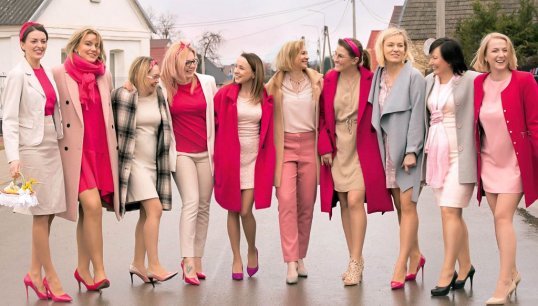
Three sisters: Iza, Kasia and Ela from Studzianki and Czarna Białostocka in Podlasie wished that their neighbourhood would be as it used to be – where neighbours helps each other, where they are not anonymous or indifferent. “Today those who move to the countryside practically do not know each other,” says Iza Zawadzka. “We decided to change it and five years ago we started organising workshops for women. Their task was to develop interests, create opportunities to try new things, but most of all to spend time together.
First there was Nordic walking. The girls looked for a Nordic walking instructor and on Facebook they invited their neighbours for a five-kilometre walk together. Then they met for circuit training, they also ran together. Even before they registered as a rural housewives’ club in 2018, they invented the name – Painted Lips – so that people would recognise them more easily. “We are constantly looking for something new,” says Ela Ostynowicz. “We invited a physiotherapist who gave a lecture on stress urinary incontinence. After that, we gathered a group of women and for a year, twice a week, we exercised the pelvic floor muscles together.”
They also tried diets and even took it a step further. “We organised the ‘Metamorphoses’ project. There was a group of 21 women who wanted to lose a few pounds. We met every week, there was a lecture (e.g. on water, movement, the role of sleep), training or dance classes. We were losing weight under the supervision of a dietitian. She measured us and weighed us, and the one that achieved the best results in the end won a ticket to the theatre,” says Kasia Zawadzka.
Girls from this club do a lot for the spirit. We started with the workshop ‘Today is the first day of the rest of your life’. After that, a support group was formed and we met for the next three years, once a month with the psychologist who led it. For example, we talked about positive egoism, how to deal with a teenager or how to motivate ourselves,” describes Iza.
Photo sessions are their flagship project. Each time they choose a different theme (e.g. rock session, winter session, pearls of Podlasie, Valentine’s Day). “There are always several dozen people, but everything goes smoothly, because we have a system. Each participant is entitled to three photos: a portrait, a silhouette and a group photo. If someone wants to have additional shots, she has to stand at the end of the line,” explains Iza. Now the girls are going to publish a calendar because there were so many sessions that they have all the material for it.
They also organise meetings which they call women therapy – they meet once a month to talk. “There are 30 of us, girls from nearby towns. Every time we meet someone else. Now a friend who lives in the forest invited us to spend the night in a hammock or in a tent,” Kasia is happy and adds, “This is not a closed group, new people keep appearing.”
“I am impressed by the energy of women operating rural housewives’ clubs and other women’s organisations in the countryside,” says Alina Kuźmina, editor-in-chief of the monthly ‘Gospodyni’ and vice-president of the Polska Gospodyni foundation, which works for women living in the countryside. “Most of them work professionally, and then still find time to meet in the club, plan activities. In the city, children are often picked up from school or extracurricular activities and do their own stuff.” In the countryside, the local community is more integrated.
In November 2018, the law giving rural housewives’ clubs a lot of independence entered into force. By registering with the Agency for Restructuring and Modernisation of Agriculture, they gain legal personality and can apply for grants. Previously, if they wanted money for their projects and did not operate as an association, they had to ask the head of the local farming circle to apply for funding on their behalf. Now they can apply for subsidies from the ARMA in the amount of 3 to 5 thousand zlotys (depending on the number of members). It is not difficult to get money and for many groups that wanted to operate in their environment, it was an effective stimulus to formalise. We currently have 9,837 units in Poland registered in the National Register of Rural Housewives’ Clubs.
Everyone can do it
In 2018, before Christmas, my friend Maria called Dorota Karaś, the administrator of the Cultural Centre in Sterkowiec (Brzesko District, Lesser Poland Voivodeship). “She stated that nothing was happening in our village and that we had to do a nativity play. She found the script on the internet and chose the role of the devil for me. I said that I would like to do it,” says Dorota.
They asked the mayor for a rehearsal room, then called friends to fill the roles. We managed to gather 17 people. “About a hundred viewers came to the première. And after the performance, we had more people who wanted to join our group,” she adds. “We took the name ‘Każdy Może’ (Anyone Can Do It), and after a few months we decided to register with the Agency for Development and Modernisation of Agriculture as the Rural Housewives’ Club in Sterkowiec. We have 31 members between the ages of 18 and 79, including 10 men.
They bought a sound system with the first subsidy from the ARMA (3,000 zlotys). The next one was allocated, among others, to get a projector, décor and stage curtains.
After the nativity play, they staged three fairy tales and a cabaret show. Some of these performances were played several times, also at the invitation of other villages. “We have a rule that if someone does not want an independent role, they are in the choir,” says Dorota. “I explain to them that we have to be together. And a lot of people eventually cave. Even those who swore never to stand up on the stage got involved.”
Due to the pandemic, the last of the prepared performances did not take place. But they managed to record it and publish it on Facebook. And now, with almost everyone in the club vaccinated against COVID-19, they have returned to their weekly meetings. “Even if someone does not want to be an actor, they can come to the community centre at 6 pm and drink tea with us. Everyone has a job to do here, but when Tuesday comes, everything is left behind,” says Dorota and admits that the biggest motivation to meet regularly is a new scenario. “When we finish one performance, we immediately come up with another one. Some people won’t come at all because they think it’s common entertainment. And we are having a great time.”
Useful and cute
Martyna Tomsia moved to Wojnowice near Wrocław seven years ago. Women like her, working in a big city but choosing to live in the countryside, are the driving force behind most of the initiatives here. While on maternity leave, she was looking for a new job for herself. “I wanted to start working with women and in January 2019 I decided to start a rural housewives’ club,” she says. She hung up posters, posted information on Facebook and invited everyone to a meeting. They started the following day, they called themselves ‘Raspberry Girls’. “Raspberries are useful, practical, have a wide range of uses, and they are also cute,” she explains.
The first Raspberry Girls’ campaign was a garage sale. Then a series of meetings with invited specialists began: a dietitian, make-up artist, beautician. They also learned to weave macramé, make dream catchers and crochet. Martyna emphasises that participation in such workshops is always free and most often women from outside the club can also join in. Lecturers come as part of voluntary work. “We make use of our friends,” says Martyna. “Members of our club perform various professions. We have engineers, a cook, I am a project manager, so each has their own network of contacts.”
After a break forced by pandemic restrictions, they have recently returned to meetings in the village common room, where they have their own room, and created beehives. “We found a tutorial on the Internet and made DIY workshops. The beehives are in our gardens, already inhabited.”
Martyna’s dream was a pink box in the common room. “My idea was supported by Magda, a member of the club acting for the benefit of women, and she bought it with her own money. Now the ladies from the neighbouring village want to put another one in the school. We support them, we suggest where to look for funds,” she says.
Exchange of services
The first initiative of the Rural Housewives’ Club in Gady (Warmia-Masuria Province, Olsztyn District), existing since 2018, was a workshop with midwives from the hospital in Olsztyn. On Women’s Day, they came to Gady and talked about the prevention of cervical cancer. It was possible to have a smear test and learn how to exercise to prevent stress urinary incontinence. “We also invited our photographer friend and make-up artists, the ladies had their makeup done and took part in a short photo shoot. We obtained products from the Food Bank in Olsztyn from which we prepared a snack. There was also an artistic part – soloists from the Olsztyn Song Studio, run by a friend of mine, came here,” says Ewa Piekarczyk, vice-president of the club. She adds that this is how they always work – based on the mutual exchange of services. Midwives had a subsidy for their preventive campaign, and the Rural Housewives’ Club in Gady provided them with the participants of the project.
Another time, the Be Creative foundation from Lidzbark Warmiński organised eco workshops in Gady. Younger children were given a treat on edible dishes, they learned how to segregate rubbish, and adults cleaned the village together. The condition was to have at least 50 participants. It is quite a challenge because earlier only a few people would come to similar events. The members of the club (there are also men) decided to combine it with grilling. There were a lot of people willing to attend the “Grill & Clean”. “Young organisations do not always have the potential to apply for grants themselves. It is worth establishing cooperation with others because together you can do much more,” emphasises Ewa.
Raspberry Girls adhere to a similar principle and willingly join initiatives carried out by others. When a company from Oława conducted the campaign “Glasses for Africa”, they collected unwanted pairs of glasses from the inhabitants of the entire commune – both corrective and sunglasses. They donated over 20 pairs. “We assume that if we do something for others today, maybe they will join our project tomorrow,” says Martyna.
All the workshops organised by the Painted Lips are free. The exceptions were meetings with a psychologist and pelvic floor muscle exercises.
Their ideas for classes are endless and they have no problem with acquiring teachers. Kasia: “We meet new people all the time. If we invite a paramedic to do a first aid course, we will help them later during a charity picnic.
Alina Kuźmina, Polish Housewife Foundation: “It’s a snowball, the more you do, the more you can do, the more contacts and relationships you have. You can’t do much on your own. It’s best to learn how to get allies.
Girls from the Rural Housewives’ Club TeraMiśki, operating near Białowieża, say that they get a hundred ideas a minute. The first was yoga from which they started their weekly meetings. Then they made regional tinctures and natural cosmetics together. And when a beekeeper friend told them about breeding bees as part of a workshop for which they obtained a subsidy, they began to produce candles. Two of the members of TeraMiśki established their own apiaries.
Their latest idea is also associated with bees – TorBee’śki, i.e. cotton bags soaked in wax for storing food. Hania sews them. “It takes about 40 minutes to make one bag. The cotton must be soaked with wax, dried, prepared in a form and sewn. If too much wax is left on the fabric, the machine will not sew it,” she explains.
Hania is responsible for the production, Karina, who is a graphic designer, came up with the name and designed the packaging.
Most of the women from the Rural Housewives’ Club in Szklana (Lesser Poland Voivodeship, Proszowice District) work professionally, but also run farms because the soil in the area is fertile. They decided to use it and created their own brand – Szklana Weka (Preserve from Szklana). They operate as a Rural Housewives’ Club, which they founded in 2018. “In Szklana there was a club previously led by our grandmothers. We found their recipes, added a few of our own things and developed four recipes: ‘Sweets’, ‘Dishes’, ‘Preserves’ and ‘Herbs’,” says Regina Musiał, chairwoman of the club.
Their two flagship products are connected with tradition. “Our commune is famous for the cultivation of cucumbers, and there is a Kościuszko oak nearby, under which Tadeusz Kościuszko rested on his way to the Battle of Racławice, so we have pickled cucumbers with an oak leaf,” she explains. “We have also restored the old local speciality – ‘springy peppers’ from Proszowice – in cooperation with the First Official Kamil Stoch Fan Club in Proszowice. We cheer together, the fan club also supports us in the promotion of peppers, we create fan sets made of preserves and gadgets.
The Szklana Weka assortment also includes green tomato jam, in spring there was a boom for violet jam, and they attracted many customers thanks to ‘buttery garlic’ – people could not believe that it could taste like that and passed it on to have a taste.
The news about the club’s products spread not only in the region, but also throughout Poland. The club runs profiles on social media and sells its own products mainly via the Internet. Shops wanting to include its offer in its assortment also contact the club.
Why, instead of just starting a company, did the girls decide to function as a rural housewives’ club? “For us, the club is a synonym of attachment to tradition, it gives credibility, it is a guarantee of quality,” says Regina. “We want to have an idea for ourselves, something that binds us, identifies and distinguishes us.”
Raspberry Honey
In Kuriany (Podlaskie Voivodeship, Białystok District) less than three years ago, a total of 15 women decided to take the initiative. They registered a rural housewives’ club called ‘Miód Maliny’ (Raspberry Honey) and started building their own brand. “We wanted to create ourselves from scratch,” says member of the club Ewelina Abramowicz. They chose raspberry jam for their flagship product and promoted it on social media so effectively that one of the sauce producers responded, proposing a combination of flavours. “The talks are still in progress. Before we start such a cooperation, we want to be sure that we are well prepared,” says Anna Gorustowicz, president of the Raspberry Honey club and head of the Kuriany commune.
When in Supraśl recently, at the Polska od Kuchni festival, they were asked why they didn’t wear folk costumes, they burst out laughing. “We do not want to change clothes, but create our image,” says Ewelina. “We are proud of the raspberry high heels and T-shirts with our logo.”
Agnieszka: “Our dream is to buy a ‘raspberry bus’ which we could use to go to fairs, festivals or competitions.
Karina from TeraMiśki admits that brand recognition is very important, also in the case of rural housewives’ clubs. “You can have a great product, but nothing will happen if people don’t hear about it. That is why we take care of the packaging, show our logo, and operate on social media.
The rural housewives’ club ‘Malinowe Dziewczyny’ (Raspberry Girls) earned for its activities, among others through sport. In the village common room, we organised pilates, yoga and zumba, we also did some Nordic walking. Each class was led by professional instructors who came to Wojnowice. Residents bought passes and in this way we gained income for our club,” says Martyna. In turn, at festivals or garage sales, they sold natural cosmetics: glycerine soaps, bath salts and raspberry sugars.
TeraMiśki argue that it is worth having a wide range of activities because then it is easier to present the club. “We produce candles for Christmas markets, cosmetics for concerts or festivals, and for sports events, Ula bakes her signature Marcinek, a regional cake according to a recipe from tsarist times,” lists Ania.
“We do not make dumplings, we do not cook or bake as a rule,” emphasises Martyna. “The exceptions are special occasions. For the 101st anniversary of Poland regaining independence, we prepared 101 cupcakes, and for an auction for an animal shelter, we allocated our signature dessert – a raspberry cloud.”
The members of the Painted Lips rural housewives’ club do not cook very much, and if they do, they do so for charity or in search of new flavours. When the girls do cooking workshops, they prepare sushi or pumpkin dishes.
The members of the rural housewives’ club in Sterkowiec focus on theatre, but they prepared 1.5 thousand portions of food for the Małopolska Festival of Taste in Brzesko, incl. three types of soups and cold cuts. The money they earned was spent on the activities of their group.
With such a limited culinary activity of the club, is the term ‘housewife’ in the name justified? Alina Kuźmina: “In my opinion, it will take on a new meaning. A host is associated with someone who embraces everything, a housewife – with a woman running around with a cloth and making dumplings. But it doesn’t have to be that way, it’s a matter of perception. In my understanding, a housewife is a person with high decision-making competences, who is equal to the host.
For others
All the people I talked to are involved in charity. Raspberry Honey helped, among others collect money for the treatment of sick children, they also baked cakes for paediatric oncology patients in Białystok, they joined a fundraiser for an animal shelter. During a cleaning event this spring, they collected 140 bags of rubbish.
The rural housewives’ club Painted Lips joins charity picnics, sells its cakes at fairs. “We try to support everyone who turns to us for help, but we focus on the inhabitants of the area,” emphasises Iza.
Rural housewives’ clubs also work for the benefit of local communities. The inhabitants of Biskupice (Greater Poland Voivodeship, Konin District) are not formally a rural housewives’ club. They have been operating as the Women’s Club association for six years. They helped raise funds for the modernisation of the surroundings of the Volunteer Fire Department, and then participated in the work. They also helped with the renovation of the facility. They obtained a subsidy for the local school and for 30,000 zlotys, they set up a biological and geographical lab in it.
“We are developing a large area called Kamieniec,” says Regina Musiał from the club in Szklana. “We are trying to raise funds to create a place for recreation there. For now, a football pitch has been created.”
Martyna from Raspberry Girls: “Our newest initiative is the Treasures of Wojnowice. On Facebook, we describe how you can use the benefits of the forest that we have nearby. We already wrote about pine syrup, now we are planning to post about ecological nettle fertilisers.
The rural housewives’ club in Budy Brodzkie (Świętokrzyskie Province, Starachowice District) organises the Neighbour’s Day, bicycle rallies, picnics and an open-air cinema. “We bought a projector, screen and sound system for the grant from the ARMA. We ask one of the residents to make their meadow available, we set up deckchairs borrowed from the municipal cultural centre and we watch films together,” says the founder of the club, Aneta Kutera.
The rural housewives’ club in Gady last summer organised summer workshops for children. “We are too far away from the city for our children to be able to take advantage of the day camp. So we decided to do something on the spot. There were two groups. The little ones had classes from 8 to 16, older children – from 10 to 14. We were afraid that teenagers would not come, and yet they envied the younger ones for being able to stay longer,” laughs Ewa.
Spokeswomen of history
Most of the members of the ‘Raspberry Honey’ club have been living in Kuriany for several years. “New people are still settling in, our village is developing. We want to get to know history and make it known to others,” says Agnieszka Malec, who wrote the project “Kuriany yesterday and today. Together, we are creating raspberry history” and she obtained money for the club for its implementation. “We organised an intergenerational meeting during which the elders talked about how it used to be in the past. Then they gave us their photos, we got to some of them by ourselves, now we want to do an exhibition in the village common room. We also intend to keep a chronicle of Kuriany.”
“Often it is thanks to migrant women that the village begins to gain energy in action again. They also repeatedly undertake initiatives reviving local history. For me, this is a very important aspect of their activity,” emphasises Alina Kuźmina from the Polska Gospodyni foundation.
Regina Musiał, the Rural Housewives’ Club in Szklana: “In 2019, our club prepared a monograph on the history of Szklana, which was presented, among others at the Małopolska Book Fair.”
Airtight mesh
Martyna has never counted how much time she spends working in the club. “I live it all the time, everything happens 24/7. I talk to people, new ideas keep coming up,” she says. “Activity in the rural housewives’ club brought me friendships that I did not expect. I have someone to count on.”
Oliwia, TeraMiśki: “For me, sisterhood is the most important value of the club. Wonderful things are born that would not have happened without mutual support, inspiration and motivation.” Rural housewives’ clubs show that women are the driving force of social life in small centres.
Sometimes they need to become immune to criticism. “Some people say that instead of staying at home and raising children, we have girls’ meetings. But we completed a three-year course with a psychologist and we know that we will not please the whole world,” says Iza from Painted Lips.
Autorka: Izabela O’Sullivan
Na zdjęciu: Koło Gospodyń Wiejskich Miód Maliny
Fotografka: Kamila Masajło
The text was published in „Wysokie Obcasy” a magazine of „Gazeta Wyborcza” on 3 July 2021