

My child hides under my wheelchair
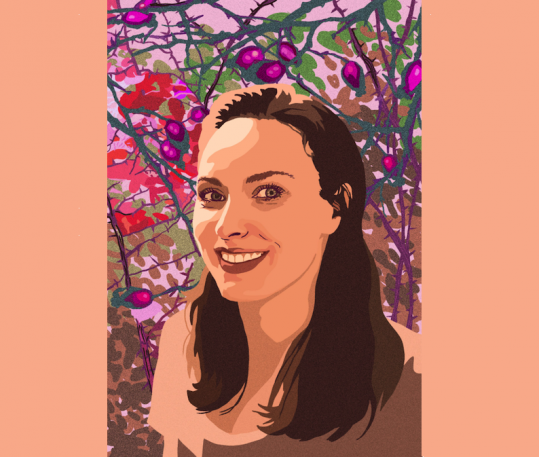
When did you hear: “Asia, you won’t walk any more”?
Pretty soon after the accident. I was fifteen when I had an accident while skiing in Italy. I damaged my spinal cord. It was 17 years ago. Since then, I have been completely paralysed from the waist down.
All of this happened to you while you were growing up. In a very difficult time.
During the transition from being a teenager to a woman. But there is never really a good time to become a disabled person. That’s pretty obvious. But in fact, the teenage period is quite an unfortunate moment in the life of every person, maybe even more for a girl. The body changes, we are super sensitive to everything that happens to it, every pimple on the forehead causes morning drama. This change has had an impact on my consciousness as a woman and on my sexuality. It was a hard experience. I had to re-learn my body, get used to it and accept it.
I remember right after the accident, I thought: “There are months of rehabilitation ahead of me to get me back on my feet and I really dislike exercising so much!” And also: “I bought myself a dress for the holidays, I guess I won’t be able to wear it now, but it will be ok for next summer.” The outlook changed a week and a half later when a doctor came to me and made it clear: “You have a three percent chance that the feeling in your legs will return.” Pretty soon I was up against the wall.
What happened next?
I had to check my life, my plans and ideas. Suddenly it turned out that my dreams were taken from me.
What did you dream of then?
What everyone at this age dreams of: getting into a good school, because I was just graduating from high school, meet a nice boy, finish studies, start a family in the future, have children. After talking to the doctor, all this was suddenly cast in doubt.
I never had contact with people in wheelchairs before. If I saw a person with a disability, I was very careful not to look because they could think that I was staring at them. So much for my contacts and thoughts about disability. So there were no patterns or ideas on how to deal with myself now, what my future might look like. I didn’t meet other women in wheelchairs for a very long time either. The rehabilitation centres where I stayed were occupied mostly by men, also after accidents. Someone had taken a dive head-first, someone had crashed on a motorcycle. But these men had a professional, private and sexual life, so I began to get it into my head that maybe it would be possible, it would happen somehow.
And did it?
At first, I clashed with reality. I’d always been a good student, so I wanted to get into a top high school. But these top schools weren’t adapted to wheelchairs at all. In the end, I ended up in a poor high school, I couldn’t come to terms with it. I worked so many years for results and now what. After some time, I managed to find a better community school that was wheelchair friendly. I had to re-introduce myself, get back to old friends and meet new ones. I was cut off from them for six months, which is quite the drama for a sociable teenager. We wrote to each other every day, spent hours chatting on our phones. We finally met up and it was an explosion of happiness.
How did they react?
They were very open. They had a lot of ideas where to take me on my wheelchair. I just said “Maybe I won’t go here” and they replied: “Aśka, come on, it’ll be an adventure!”. We used to go to clubs, cafés, cinemas and parties together. We went on vacation together. It turned out that I could move anywhere in this wheelchair, alone and with the help of other people. Even to a club in the basement – I never heard: “Girl, you can’t get down here.” The security guards carried me up the stairs as necessary. Everything was going well. I believe my teenage years are pretty close to the memories of a person who hadn’t spent them in a wheelchair.
But I didn’t always feel good.
When, for example?
Sometimes, when we went to pubs, I wondered if my friends were not ashamed of me being in a wheelchair. Because they’re so cool, fashionably dressed, pretty, and then there’s me. The accident affected my self-confidence. I told them about it. It turned out it was all in my head. That I thought I was different from them because I was in a wheelchair and they weren’t. But really being different doesn’t mean anything worse, it’s nothing to be ashamed of. Being different is interesting, cool, so I found myself interesting too. Sure, my body looks different. Also, think about it: how many people have an ideal body? What is an ideal body, anyway?
I stopped being afraid, wondering if people were staring at me. Sometimes people still ask me in queues or in taxis: “You’re in a wheelchair! What happened to you?” I don’t consider this question uncomfortable, intrusive and it doesn’t annoy me. I answer. And then it usually turns out that someone has a family member with a disability or knows someone who is in a similar situation to mine. I have other experiences, it is like that, but it can also be interesting for people.
After that, did you put on the dress you bought for the summer holidays before the accident?
I don’t like showing my legs. I have other advantages: a smile, breasts, intelligence, this is how I create my sex appeal. Being in a wheelchair, I had to learn which aspects of my physicality I like, which are the strengths that I emphasise to flirt sometimes. Because the fact that a person moves in a wheelchair does prevent them from having a crush, from courting and teasing. I don’t see any difference between me and my friends – regardless of whether a girl wears high heels or wheels. An accident doesn’t rule it out – you can flirt, woo, be playful, it doesn’t get in the way at all. A wheelchair is simply a means of moving around.
In high school, we would often go to clubs with our friends looking for boys, and I had a lot more success flirting. Even then, I was convinced that I was a cool girl, unique. Without this belief, it’s hard to win over others.
I remember a boy I liked a lot at school. We started dating pretty quickly, everything turned out completely natural. But it was me who took the initiative. I don’t know if it’s a question of my character, the times we live in, or something else – but I think that sometimes a girl has to take the first step. You can’t just wait and dream about a romantic relationship all evening. It’s necessary to go out into the world, to love, to dare. There’s nothing to lose.
When you started seeing your boyfriend, did your family not warn you: “Be careful because he will leave you, you will suffer more, blame yourself?” I am asking because I know a person with a disability, whom the family tried to protect from harm, and limited her contacts in the name of false care.
I have the second type of parent: supportive, strengthening. My father used to drive me to club events then he picked me up so I wouldn’t have to take a taxi. He never had a problem with it. My mother went on vacation with me and my friends to help me a little, e.g. with changing into pyjamas, getting into bed. My parents did everything to keep me away from home. I never heard any discouraging words: “Pace yourself”, “Are you sure about these studies?” “Are you sure about this boy?” They said: “Do what you want, learn what you want and meet whoever you want. Just be happy.”
We had a normal, successful relationship. I overcame my prejudices against myself. I was ashamed of my legs, the scar on my back, the traces of surgery, but it turned out that only I had a problem with it, not my boyfriend. I was more stressed than it was worth, like any girl of this age who unnecessarily convinces herself she has too big a belly, too small a belly or a growing one, the wrong kind of nose. It turned out that I was special for the boy. I was no longer ashamed of my body and I wasn’t embarrassed to visit doctors.
What was your first visit to the gynaecologist like?
I was with my mother, probably 18 years old. I actually went for the cervical cancer vaccine, and I also got myself birth control pills. Like any responsible girl, I protected myself, I wanted maximum protection. My mother’s eyes widened, but I approach my sex life very consciously. I had an examination on the couch, it was done without a problem. For me, this is the only option available. I am not able to get into the gynaecological chair. When I got pregnant nine months ago, I had no problem finding a good doctor, a gynaecologist who has experience with girls in wheelchairs in the field of pregnancy management. I went to tests alone or with my husband.
Where did you meet?
At the festival in Jarocin, eight years ago. I used to go to festivals a lot. He was a friend of a friend from college. We quickly moved in together, we have a nice relationship and after many years we decided to have a baby.
The Avalon Foundation, in which you are involved, has been dealing with the stereotype that disability precludes a successful, colourful sex life for years.
Because it’s a myth. Everyone is a sexual person. I have the impression that when people with disabilities have sex, it is more conscious, reflective, that it is deep sex. We are more aware of our body, we must understand it, know how to enjoy sex, teach our partner how to give us joy.
I need to know exactly what I want, what I like, what gives me a sense of joy and satisfaction, so that both my partner and I feel nice and pleasant. I have always known what works for me, I knew how to properly direct my partners, and I am satisfied with this aspect of my life. There are also erogenous spheres on the neck, hands, behind the ears, so everyone can find their G-spot. You just need to know what you like and your own body.
Because a good sex life means two satisfied people. I am very sad that some women give up on their pleasure, on searching.
I like how you openly say that you don’t treat sexuality as a “taboo” subject. That I can ask about sex, orgasm, menstruation.
I am sorry that the word “taboo” is used – repeating this is counter-effective for women, it is not taboo. We are talking about our affairs. Perhaps men are afraid to talk about women’s periods, although they shouldn’t be afraid of it any more. 50 percent of society experience menstruation, it is not taboo. People with disabilities also have periods. And they also struggle with sanitary towels, tampons and wonder if menstrual cups are a good choice in environmental terms, or whether to choose organic cotton pads, or maybe reusable pads. We have the exact same problems and dilemmas. Sure, it’s harder for me.
The world isn’t adapted to me, so I have to adapt to the world.
Because the world, unfortunately, does not consist only of places with ramps and adapted bathrooms.
If I have to do my business without closing the door behind me because I can’t get there in a wheelchair, then I do so. It’s tough, uncomfortable, it puts us at risk because nobody wants to pee or change a sanitary towel with the door open, and nobody likes asking strangers for help. This is a terrible inconvenience. But I live with such inconveniences.
I often have situations like this when I’m sitting at work: I want to go to the bathroom quickly, change my sanitary towel and suddenly there’s a problem because it turns out that changing sanitary towels when you are in a wheelchair is really difficult and won’t take two minutes. This is annoying: it wraps here, it tucks there. I am aware that the problem of changing a sanitary towel on a wheelchair affects a small portion of women, so manufacturers don’t take this into account. But these are the little frustrations of everyday life.
It’s hard to have a sanitary towel or a tampon while sitting on a wheelchair. If you look at my life, it’s a bit more difficult than other girls’ lives. They will change their sanitary towel more easily, they will pick the baby up off the floor faster, or they will breastfeed faster. For me this is a whole series of movements that I have to make.
The research of the Avalon Foundation shows that as many as half of people with disabilities don’t intend to have children for fear that they won’t be able to cope. It’s stuck in our heads.
But it’s also in the minds of society. When I got pregnant, I heard from my friend who had become a mother before me: “Oh, Asia, I can’t imagine how you’re going to do it!” She had no bad intentions but implied that I wouldn’t be good enough as a mother. Because you’re a girl in a wheelchair, how will you change the baby? How will you go for a walk with your baby? Everything can be dealt with. My parents helped me with my walks. They took their granddaughter outside and I had two hours to myself. Later, when my daughter was older, I took her on my lap, secured her with a scarf and this is how we started going for walks. I knew that there was no other option, that I would manage, that I would take her in my arms, lift her and breastfeed her in the same way. It was just hard for me to figure out how to do it, I couldn’t imagine it when I was pregnant. During pregnancy and even before it, I had a lot of concerns.
Like what, for example?
I was very scared of how it would affect my body. How my body would handle it. I am paralysed, it is something unusual in the management of pregnancy. I was afraid of what I would look like, what my life would be like when I gained 30 kg. Because now I move using my hands – would I be able to move around on this wheelchair weighing 80 kg? Would I be able to lift myself onto the toilet? Would I be able to get in the bathtub by myself, using my hands? Would I have enough strength to lift myself?
If I got fat, what would it be like? How would my circulatory system react? Would I not have abrasions on my buttocks because I was sitting in a wheelchair all the time and I would gain a few extra pounds? I was also afraid of whether something might go wrong with the pregnancy. What if I wanted to end this pregnancy? I was afraid that I would find a doctor who would order me to go through with it, even if the foetus was deformed. Not because disability influences it, but because we live in a country where the woman isn’t allowed to make the decision.
Fortunately, I went through my pregnancy very well. I didn’t feel sick, I only gained 9 kg, I was weakened, sure, but when I was pregnant I didn’t see it like that. I felt full of energy, travelled, went to my friends’, and two days before the birth, I was still going to parties.
I had a caesarean section. I had a mild puerperium, I am paralysed, so I missed the postoperative pains. Of course I was confused, scared, but I was quite well prepared for this birth. I knew all the guidelines of the Childbirth with Dignity Foundation so as not to find myself in a situation where I wasn’t in control of something.
What was your biggest problem at the beginning of your motherhood?
I thought that I would not be able to wash the baby by myself. It turned out that yes, I wouldn’t be able to put it in the bathtub without the help of my husband, but I could safely do it by myself, in the washbasin, with a suitable pad. My husband works on call, so he would often be gone for a day or two. In the end, I had to wash the baby myself. There was no way out.
How did you come up with this solution with the sink?
I was looking on the internet. It turned out that washing a baby in the sink is completely normal. You buy a special pillow that you put in the sink, and it is easier for me to put my baby daughter in the sink than in the bathtub.
I really wanted to be an active mother. To take care of my child by myself, to go to various classes with my daughter, mother meetings, but my motherhood happened during the pandemic. I had to stay home even though I had imagined it differently.
I remember the first time I went alone with my child to my friend - what an important moment it was for me.
I have a customised car where I can fold my wheelchair in the passenger seat and go wherever I want. One day when my husband was away, I was sitting alone but I wanted to visit my friend. I took the baby on my lap, in the scarf, and then placed her in the car seat. It worked. It was very important and liberating because I was able to fully enjoy my motherhood.
Are you still breastfeeding?
Yes, I am. I found my own way to lift my daughter, latch her onto my breast, play with her or change her clothes. At the birthing school, they showed us: “Well, it’s so simple, you approach the child, turn it from one side to the other, of course, safely holding, here are the sleeves, trouser leg and it’s dressed.” In the case of walkers it certainly looked like this – although I assume that the first time changing a child is a traumatic experience for anyone – while I had to find a safe position for us, my own way to dress her. I don’t have abdominal muscles, so I often use one hand for various activities. I have to do a lot of things with my child in this way. It takes a little more time.
When a mother wants to pick up a crawling baby from the ground, she comes over, crouches and picks it up. I have to stop in the wheelchair, find a good place to put my daughter down.
But on the other hand – I don’t know any other kind of motherhood, so for me it’s normal.
I think that perhaps in the evenings I have sore muscles more often than my friends who are not in a wheelchair. But I also have other small problems because the baby, who is crawling now, hides under my wheelchair. Or she sits down in the middle of the corridor and you are unable to pass by either side. Mothers who move normally don’t have such problems. I also laugh that because of my being in a wheelchair, my daughter quickly started to get up because she was climbing up the wheelchair like up a ladder. It was her favourite position.
And my daughter doesn’t seem to feel that I am not fully fit. For her, this is what mum looks like. It’s completely natural.
Monika Tutak-Goll talks to Joanna Zielińska*
- * At the request of the heroine, her name was changed.
The interview was published in wysokieobcasy.pl 12 September 2020

People with disabilities often experience exclusion and discrimination in the context of sexuality and parenting. As a rule, society doesn’t notice, places taboos and sometimes even denies their needs. In response to this, the Sekson project was implemented by the Avalon Foundation in cooperation with the Kulczyk Foundation. The aim of the project is to change stereotypes and attempt to influence the perception of people with physical disabilities, as well as to increase social awareness of the needs and barriers that people with disabilities face on a daily basis.