
So as not to be another breast to be cut out
‘You'll be fine!’.
Magdalena Bator: A lot of people promised me that. And I pretended to believe them. Because nothing could be right if I got breast cancer.
I found out about it four years ago. All the doctor had to do was look at the ultrasound. When he gave me the diagnosis, I left the office, handed my purse to my husband, and headed to the bathroom. Nervous… okay, I’ll say it, although it’s very intimate. I didn’t know whether to sit on the toilet or throw up first. As I bent over the sink, I felt like my body was trying to get rid of the danger immediately. When I got home, I was jittery. I fell to the floor. I cried. Mikołaj laid down next to me and hugged me.
Weronika Szwejk: And then, mum, you called me. Without further ado, you said: ‘I have cancer’. I thought straightaway: ‘Why you of all people?!’.
Isn’t there anyone else?
W.: Like me. I didn’t understand why cancer spared me. I was at risk. All my childhood I heard from my mother and grandmother that I could get sick because my grandmother had breast cancer. They also told me that cancer likes to attack every second generation. So I never expected my own parent to get sick.
M.: My mum had both her breasts amputated. She hung up notes all over the house on how to examine herself. What I don’t understand is why we threatened you with the disease. How nurturing…
W.: That wasn’t so bad. Thanks to my grandmother, I learned to self-examine. And since we didn’t treat nudity like a taboo at home, I saw her with amputation scars. Mum, I think we’ve always been such a family – direct and honest. If anything happened to any of us, we’d put all our hands on the deck. It was the same with your illness. When you told me about the diagnosis, in two weeks I closed my life in Stockholm and came to Gdańsk.
And you, Magda, went for a biopsy then. You needed confirmation.
M.: It was a formality. I sat down in front of the office, looked around, there were a lot of women waiting for a similar result. After an hour of delay, I went to the doctor. ‘I have two messages’, he told me. ‘A good and a bad one. Bad because you have cancer. It’s good because you have a one, which is the first stage of cancer. It gives you a good chance of cure’. After leaving the office, I immediately called my husband. He didn’t make it to me because he was coming back from the airport. Delighted, I said over the phone: ‘You know what? I have cancer. But first degree! Maybe I’ll get better!’.
Oh, that’s nice. You’re laughing now, and your daughter’s crying.
M.: I’m laughing because I just realised that I cared less about cancer and more about its stage.
You know what I needed back then? Warmth and care. Also from the doctor. That’s why I was trying to establish a relationship with my surgeon before the surgery. I was hoping he’d remember me, and I wouldn’t be just another breast to be cut out for him. So I told him about my husband’s plan to take me to my dream Paris a few days before the procedure. ‘I see no contraindications’, the doctor replied dryly. Then I talked to him a few more times. Well, it worked. When I got back from France, he asked how it was.
W.: It’s not his fault, mum. It is not easy for doctors to inform patients about cancer on a daily basis. And now your behaviour has made me realise how much you needed tenderness.
M.: But I didn’t want tenderness only for myself. I wanted it for all patients. Because cancer is loneliness. In this illness, no one could promise me anything. Even in remission, I was afraid of a metastasis. However, I felt most lonely when I was taken to the operating room. I remember lying naked under the sheet and realising: Oh God, I will be at the mercy of strangers!
W.: Meanwhile, my little sister, Mikołaj and I were home. We were in bed together. We were staring at the ceiling. We weren’t even talking, we were just watching the phones. The presence of Mikołaj helped me a lot. He was like a drummer – he beat the rhythm of our family with his calmness, and we followed him.
The surgery went well. What was the hardest part about it?
M.: The doctors excised the tumour with a large margin. So I lost a piece of my body. I was afraid to take off the bandages afterwards and to see the scar. When I finally did it, I was surprised – my body did not repel me at all. I felt neither resentment nor anger towards it. All I could say was that I had a mission to take care of myself. I wondered if my behaviour – fast life and food – did not contribute to the development of cancer. That’s why I put down sugar, dairy, meat. I switched to a plant-based diet. This, I note, did not heal me, but at least it gave power to my body.
One worry was definitely gone – some of the patients were afraid that their partners would stop liking them after the surgery. It didn’t even cross my mind, because Mikołaj said, ‘It might be nice to look at young women. But eroticism and sexuality are in a mature body. Young bodies look alike. Only the slightly older ones can tell the difference’.
W.: And I have a feeling that after the surgery, you became more aware of your femininity. Before you got sick, you always painted your lips red. You wore uncomfortable suits. You didn’t even have flat shoes for a while, and you were wearing heels when going to childbirth! You were a corporate animal.
Did you like yourself at all?
M.: No. And I don’t want to meet myself from the past. Before the surgery, I worked in a chain of grocery stores. I managed a few of them. Nothing was more important to me then. That’s why I couldn’t rest. I always felt like I didn’t deserve to relax. I worked hard to compensate for my childhood, in which I was underestimated. That’s why before the surgery, I called my boss and warned him: ‘I have surgery in July, then radiotherapy, but I’m back in October!’. Mikołaj listened to this conversation. When I hung up, he told me to dial my supervisor’s number again. And tell him I’m never coming back. ‘You must be joking,’ I resented. ‘I have cancer, and you’re telling me to quit. I’m not giving away a company car, fuel cards, and my fixed and good salary. What if one day we don’t have enough for medicine?’.
And yet you quit your job. And then you admitted that cancer ‘saved’ your life.
M.: Otherwise, I’d still be in the corporation. I would still say to my husband: ‘And you know, because in my stores...’, to which he would answer: ‘I must disappoint you. These aren’t your stores’. Apparently, I needed the surgery and cancer to understand his words.
W.: Mum, your illness has done something else – brought us closer together. Remember when we used to fight? We didn’t even talk for a while. As a result I moved out pretty quick, before my graduation. I think we couldn’t talk about our needs. There was no communication. But now a lot has changed. I learned to meditate because of your illness. It’s my lifeline. And even if we argue and there is a momentary storm between us, I still feel that there is peace under the surface of this ocean. In addition, we realised one thing – we have each other.
M.: Sometimes I can’t focus on that happiness yet. It’s impossible because of my fear of a relapse. This fear has made me panic. Once my hip hurt, I immediately called my oncologist. She did an abdominal ultrasound. Nothing. Then another test. Nothing, either. That’s when Mikołaj intervened. He asked why I associate every condition, even pain in my toe, with cancer. ‘Because I feel like I got sentenced four years ago. And that the surgery only postponed it’, I replied. I went to the osteopath, just in case. And since we knew each other, he just said, ‘Damn it Magda, it’s just your hip’. And I sobered up.
A breakthrough moment for you was a workshop on Hellinger settings.
M.: The title was: ‘What does my illness say about me?’. It consisted in someone from the group impersonating your condition, although they did not always know what it was. Then they staged a conversation with you. I didn’t talk about my illness. However, some dared to talk about obesity, anorexia, slow loss of vision. When the time came for the role-play, a girl impersonated my illness. We stood in front of each other. She looked deep into my eyes. And then she suddenly knelt down. She started crying. And repeated: ‘I won’t kill you! I won’t! I’m just here to teach you something’.
I cried, too. I couldn’t recover for an hour.
As if that were not enough, Mikołaj soon quit his job.
M.: While I was still on my sick leave, he came up with the idea of a new business. He used to make me beetroot sourdough every day. First of all because beets helped me recover after surgery and radiation therapy. Secondly, they had anti-cancer properties. In October, Mikołaj went on – he bought a hundred bottles, filled them with his sourdough, corked them, covered them with grey labels and announced to me: ‘We’ll sell it!’. By the way, he stated that he would resign from his previous job, that is, the position of the president of a listed company. ‘Great, now the two of us will be unemployed’, I concluded.
When I felt much better, Mikołaj suggested that I use my own experience in commerce and sell these 100 bottles. So I got in the car, and then I drove around the grocery stores. I sold everything in one day! Then we took off in full swing. In the morning, I poured sourdough from a 20-litre pot into bottles, labelled and corked them. When I returned from the detour in the evening, I sometimes helped my husband. Because he came up with another thing – vegetable cuisine in jars.
W.: Finally, we started to take our products to the bazaar. We sold them like farmers. We met my mum’s friends there. They could not believe because they had always associated her with the corporation. And there she was standing in front of them in the cold, wearing a winter hat and a jacket, selling them sourdough. ‘Magda’, they responded, ‘with your expertise, we’ll get you a job in two weeks!’. And mum protested. And very good, because thanks to this, our company – the Sourdough Plant [Zakwasownia] – was born.
But also the foundation that was created.
W.: The customers at the bazaar pushed us into it. Among them were cancer patients who asked what to eat as part of cancer prevention. Of course, we told them, but we also pointed out that we are only producers of healthy food, not doctors.
M.: Or therapists, because sometimes there were dramatic scenes at the bazaar. I remember a lady who grabbed my hand. ‘I have inoperable lung cancer’, she said. ‘Magda, what now?’. There was a little girl next to her. And a husband with a shaky chin. We have experienced similar situations five times a day. We couldn’t leave those people behind. That’s why Mikołaj said we should start a foundation. We were just wondering what exactly we could do.
Fortunately, my five friends from the former work joined our company earlier. Among them – Agata, who was the head of the HR department there and who in the meantime trained as a psychooncologist. We consulted on how to help cancer patients and their families. Collecting money for operations? No, we didn’t feel competent about it. But we could give them tenderness! Because that’s what I missed most in my treatment. Soon after, I listened to the song ‘Departure’ with my friend Emilia. Renata Przemyk sang in it: ‘It’s not you who make the paths
You have no influence on their finish’. After these two lines, we came up with the name of the foundation – Tenderness Station! The station, because it is a place where we wait, take our time and do not make rash decisions.
As part of the foundation, we offered free help from an oncologist and psychooncologist. We simplified it as much as possible: it was enough to enter our website, choose a date and leave your contact details, so that the therapist could call back on this number. At the Sourdough Plant we also thought that part of the profit from the sold oxymel, i.e. a beverage made from macerated vegetables and roots, would support Tenderness Station. And you know what? No product sells as well as this one. There’s just good in it.
You’ve recovered, and yet you’re still surrounded by people who are ill.
M.: It wasn’t easy for me at first. After dealing with cancer patients, I often thought about my own cancer. I was even afraid I’d get a relapse. The hardest part for me was with a small group of women who acted like energy vampires. When they called us and I tried to figure out what kind of help they needed, they just kept saying, ‘I don’t want that boob! Let them cut me out of everything’. ‘Remember that you are talking about your body, which has served you so far’, I replied. ‘That’s the breast you used to feed your children. You speak badly of it because it is ill. If there’s something wrong with your tooth, would you hate it too?’. ‘Oh, no...’. It also happened that I received ten messages a day from a certain patient. In each one, she wrote about self-hatred. I talked to her for a while. Then I stopped because I didn’t know what to write back. I wasn’t a psychooncologist.
But I understood these women. With their messages, they didn’t want to hurt anyone, they didn’t do it out of spite. They were just scared and panicked in the face of the disease.
W.: I once met a client of ours. She used to come to us in a wig, always smiling and skipping the subject of her illness. Her husband used to come with her, too. At the time, the three of us pretended that everything was normal. But then one day, when she went to the bathroom, I asked her husband, ‘Has your wife had chemo?’. ‘Yes’, he replied, ‘and she told me nothing about it. She also kept quiet about the surgery she had because of the cancer. She lied about going to cut the mole out’. First, I got mad at that woman. Then I started to understand her. And in the end, I felt sorry for her because she wouldn’t let anybody help her.
Then such situations triggered anxiety in me. I was worried my mum might be ill again. Sometimes I even lost count, whether I was afraid for her or for myself. Today, however, I have learned to tame this fear. I found it helpful to say what we have in Sourdough. That if there’s a problem, you have to massage it. And so I did with my fear.
Maybe that’s where your project ‘Wrap yourself in tenderness’ came from?
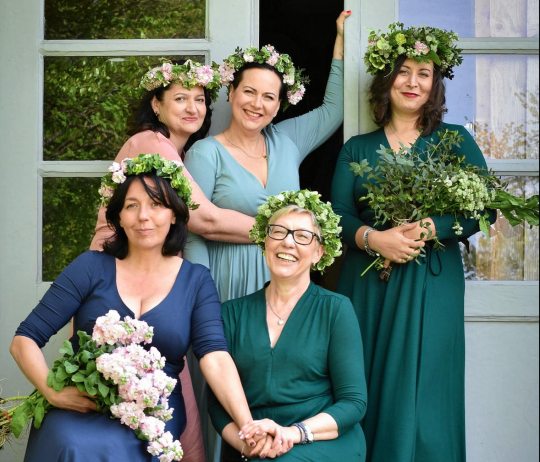
W.: It’s a long-term campaign within the foundation. Of course, I was inspired by my mother. I saw that cancer made her sensitive to her own body. To its natural beauty. That’s why, as a photographer, I invited my mother and four of our foundation’s charges to a photo shoot. Every one experienced by cancer. They came to the meeting in one car. When they stood in front of the barn where we planned the photos, their faces fell. There was shame. One of the participants admitted that her partner laughed at her before leaving for the session. In his opinion, she weighed too much, which made her unsuitable for contemporary canons of beauty. The second woman did not understand how she could pose after a breast amputation, even in a dress with a neckline.
As soon as I heard that, I invited all the women into the circle. The kind in which our great-grandmothers used to talk. We breathed a little, stretched a little. I then pointed out that the camera was supposed to show their beauty, not highlight the imperfections that each of us has. The participants then told how they were feeling today. They were talking about fear. The bellies they don’t like, the asymmetrical breasts, the crooked nose. Then they all went for a very delicate and natural makeup, put on RISK made in Warsaw dresses, and then stood in front of my lens and my colleague Przemek. What happened there! Quiet, shy women turned into fiery babes in a few minutes.
M.: One of the participants had two relapses of cancer. Once a week, she visited the Amazon club and supported other women. And yet her smile didn’t leave her face in the session. ‘It’s amazing that you have so much energy’, I accosted her. ‘Magda’, she laughed, ‘there’s no room on my torso without a scar. But what matters is that I can be with you today and weave garlands’.
W.: After the session, I showed the photos to my friends. None of them believed that there were unprofessional models in the photographs. More importantly, they may have ever had cancer.
Magdalena Bator – four years ago, she suffered from malignant breast cancer. Together with her husband and family, she founded the Sourdough Plant [Zakwasowinia], an organic food factory. She is the founder of the Tenderness Station foundation, which supports oncologically ill people and their families.
Weronika Szwejk – photographer, PR manager of the Sourdough Plant. The author of the project ‘Wrap yourself in tenderness’. The daughter of Magdalena.
Author: Łukasz Pilip
Photo: Weronika Szwejk
The text was published on wysokie obcasy.pl on 27 November 2021