

Today, people are the cheapest in the history of slavery
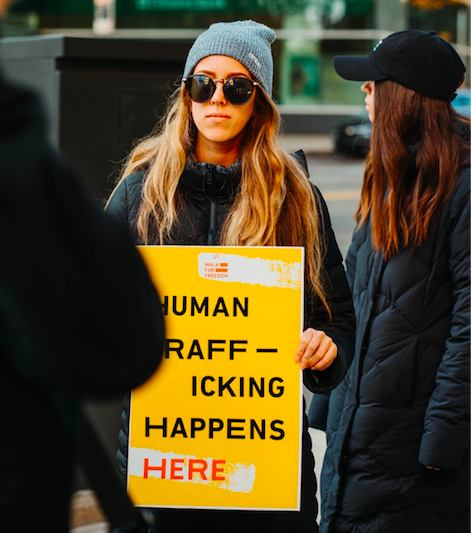
Can you or I be a victim of human trafficking?
- Recruiters rely on the deficits of potential victims. We all have deficits and we could all be recruited for forced labour, but no one will do it in relation to you or me.
Why?
- Because it wouldn’t pay off. It would be too laborious and not worth the price to keep control of us. For example, I am not very strong physically, young and beautiful, so the earnings would be small, and due to my communication skills, I would have a lot of escape opportunities and I would have to constantly be monitored. We wouldn’t bring a lot of income. Just as kidnapping doesn’t pay off. It’s too risky, it’s better to persuade them to leave.
How do human traffickers earn money?
- On the forced labour of others, including sex work. I also mean selling organs, e.g., someone decided to sell a kidney, left secretly from family and friends, and had more organs taken on the spot, and never came back. Victims of human trafficking lose their lives for various reasons, e.g., exhaustion, because they work too long and too hard.
How is the recruitment process for forced labour carried out?
- The moment of recruitment is the moment of fulfilling dreams. A recruiter is like Santa Claus or a goldfish that grants wishes. Later, when it turns out that we are trapped, it is difficult to give up these dreams. We are dealing with an entire psychological mechanism.
The recruiter searches for a person who has dreams and persuades them to fulfil them, to leave. On the spot, the recruiter explains to the person that they are not able to free themselves and that the only thing that will help them is cooperation.
We are now working in the foundation with a man who did not testify for two years after returning from the UK, because he was afraid of the people who had trafficked him and forced him to make drugs. He began to cooperate with law enforcement bodies only when he had no other option. And yet when he was offered a job in England and earnings of several thousand, he thought it was a dream come true.
Who are those among the 40 million people in the world who are modern slaves?
- Recruiters choose people who can bring an income. After all, trafficking in human beings is all about money. These are people who succumb to disinformation easily, who can be intimidated and made to work for free. For example: they can be people recruited for manual labour, because the lack of knowledge of the language prevents them from seeking help, but also from communicating with outsiders.
Such people do not seek help also because they feel bound by debt. The debt is bogus or exaggerated, but victims believe that if they pay it back, they will be free. However, new penalties, exaggerated amounts are imposed, and the debt is never repayable.
Recently, we have met a lot of people from Latin America who are convinced that if they can come to Poland without a visa, they have the right to work here. Such people have invested in coming and when they find out on the spot that they do not have a work permit, they cannot simply pack up and go back home.
People who have never left their country are not well versed in migration regulations. They are often desperate, in a difficult financial situation, need money for their families as soon as possible, and the intermediary is a source of information that seems credible. He shows documents in a foreign language, photos of the hostel where they will live. Often, such people sign documents that they do not understand, and then it turns out that they have obligations towards the other party and are afraid. They don’t know what will happen if they don’t keep them.
If they come from a country where citizens fear police brutality, they will not go to the police. Besides, no one will understand them there, at least at first.
For us, the biggest challenge is people only transiting through Poland, being transported to Western Europe, sometimes they do not know yet that they will be used there, that someone has paid for them. Two such teenage girls were in the group trying to cross our eastern border. Fortunately, the Border Guard correctly identified them.
Poland is a country that victims of human trafficking are taken from, but there are also people who are forced to work here. Citizens of which countries are affected by this problem?
- Ukraine is still one of them. Trafficking in human beings is directly proportional to migration. Human traffickers operate where workers come to us from. The Philippines are doing a lot to limit the exploitation of citizens abroad, but Filipinos still fall victim to human traffickers because they often migrate for work. This also applies to other Asian countries that are a source of cheap labour for Poland – Vietnam, Nepal and Bangladesh.
What was slavery centuries ago and what is it now?
- That slavery was legal, related to the legal order, for example in Dutch colonies. Nowadays slavery is a crime. Pursuant to Article 115 paragraph 23 of the Criminal Code, slavery is a state of dependence in which a person is treated as an object of property. The slave can only think voluntarily.
In Poland, no one has been accused of such a crime in a long time. The two women who worked for diplomats from one of the Arab countries were closest to slavery.
They worked 12-14 hours a day, ate table scraps, had limited access to the bathroom, and were humiliated, forced to dress like Muslim women, even though they were Catholic.
There was also physical violence. One of them had unfinished formalities, so she was staying in Poland illegally.
The term “modern slavery,” which is popular around the world today, is not the same as making someone a slave in the legal sense. It is a much broader concept that covers both victims of human trafficking and victims of forced labour of varying degrees and types of enslavement. Modern slavery is about using people for financial gain, depriving them to a large extent of their freedom and treating them only as a source of income. One of the characteristics of forced labour is that the person working in this way is convinced that they cannot leave the job. People who have never found themselves in a situation of coercion do not understand why people are stuck in it, and they are stuck, because this is their horizon of thought, they have such information about the world and about themselves. Perpetrators use various methods to convince people to stay and not to go away. This is their source of income.
But today people are the cheapest in the history of slavery.
- It’s hard to compare, but indeed, once the value of a person was greater, and this is because there were very few machines. For this reason, the value of the “human machine” was greater economically. Today, many activities that humans used to do are done by machines. That’s the whole reason.
Why are as many as 71 percent of the victims women and girls?
- There are several reasons. Migration is becoming more feminised. In the past, mainly men migrated for work, women came to them later. Today, many women go to work abroad. In some countries more women leave than men. There was a moment when there were more Ukrainian women than Ukrainian men in Poland. Work for migrants is often typically female work, and thus – low-paid. Women are needed for sex work, care and cleaning work, for work in catering and auxiliary professions. Factories also employ women. There are few jobs where there is a majority of men.
Are Polish women victims of human trafficking?
- Yes, Polish women are still victims of human trafficking, although today these situations are different, we are in the EU, and we can work legally, and so, for example, you cannot intimidate a Polish woman that she works illegally. I know the situation of two women who went to work and were threatened and forced into marriage there. They were tightly connected with each other, so one way to bully them was to keep them apart.
What should stand out as worrying to a woman so as not to be recruited into forced labour?
- That you have to leave very quickly, that you have to pay the recruiter for mediation (in the EU, the recruiter is paid by the employer), that there are no clear working conditions, no contract, no specified number of working hours. Avoiding answers to questions about future work, or answers such as: “You’ll see when you get there” or “You’ll like it” should be disturbing.
Occasionally, exploitation is created by contracts whereby people are provided with food and shelter for which they have to pay but are not given a fixed number of working hours. They earn so little that they can only support themselves.
What else should worry us? Definitely, contracts with provisions stating that the rates are to be determined, with contractual penalties. And the lack of a contract should discredit such an employer at the start. We should also be concerned about overly attractive and inadequate offers. For example: a woman gets a job offer as a sheikh’s secretary, but she does not speak any foreign languages or doesn’t know how to use computer programs. So the dream offers I mentioned.
The recruiter’s shortening of the distance is disturbing, as is the interest in family and personal life. Recruiters often choose people who are lonely, at odds with their family, so no one will come after them quickly.
If a girl, a young woman, is recruited for a job, such as picking blueberries, and hears that she cannot go with her boyfriend, that is certainly cause for concern. If something worries you, you can call La Strada and we will analyse the job offer together.
What do La Strada and other such organisations around the world do to prevent trafficking in women and girls?
- La Strada was established as a foundation against trafficking in women. When men started to appear and it was hard to know where to direct them, we expanded our offer. However, we are still a women’s organisation, this is our identity. Almost all our employees are women, but we help men as well. Well, maybe the methods are a bit different.
We run information campaigns. We have prepared a board game “Lucky Girl,” which we make available in school and educational centres. We always respond when women’s magazines contact us. We conduct information campaigns in labour offices. We try to reach schools, keep social media accounts, we ask our ambassadors to speak out. We show ourselves as a group of women who are strong and do important things. And we are not afraid.
Currently, as part of the Anty Modern Slavery Gallery campaign, we are trying to build social capital to counteract forced labour, to reach people who, although not directly threatened, do not agree to human trafficking and exploitation. It is these people who can influence their environments and pay attention to irregularities, e.g., when recruiting for work and employing foreigners, and sensitise others to such situations.
How long were the people you are dealing with in captivity? Five years? Ten?
- No, not ten, but seven, yes. Such a person has to bring in money, and when they stop, the business does not pay off. How do victims of trafficking end up? Some of them turn to the dark side of the force, so to speak, which means they start cooperating with the criminals. Some try to escape, which may end well for them or tragically, but we do not always find out about it. Sometimes we only get questions from the police about the body of, for example, a young woman found in a sewer in the Netherlands.
Victims of human trafficking are said to be sold into films with a fatal outcome if they do not cooperate. It is the fear of women who are forced into prostitution.
The iconic figure of the victims of human trafficking is Olena Popik. Even the play “Rose of Jericho” was written about it. She died in the 1990s. Her identity was revealed because she had AIDS and multiple STDs when she was dying in hospital. The idea was for her clients to see a doctor.
How is freedom taken away?
- Let me give you an example. There was such a case in Poland: people from a non-Catholic country were forced to work in the factory. The employer did not let them go outside the factory, but not because he forbade them, he just repeated: “Do not go out into the city, it can be dangerous for people from your country there, you look different, you have no documents, and we will deliver everything to you.” These people couldn’t find any counter-arguments, or maybe they believed the employer. The impulse to escape from this factory was the arrival of a Catholic woman who declared that she had to go to church on Sunday. Her employer drove her, and it suddenly became clear that the world beyond the gate was not dangerous, that it was possible to get out. A dozen or so people ended up escaping from this forced labour place. They used sheets.
Exactly, how do the victims manage to escape? By accident?
- I’d like to know the answer myself. One thing is for sure, the easiest way to get away is in the first two weeks. After this time, a person begins to see themselves differently, on the one hand as a result of physical exhaustion, and on the other – negative mental training. With the passage of time, it becomes more and more difficult to escape and it happens most often by accident, e.g., some form of audit.
Humans are, in a sense, depriving themselves of psychological freedom. An unpaid worker has more money to get back and it is harder for them to walk away. They think they’ll pay them eventually, and if they get away, they’ll never get their hard-earned money back. It’s easier to give up 500 zlotys than 15,000. You think they will pay you in the end, and if you run away, they will never pay you.
How do you start working with a freed person at La Strada?
- We start with the question: “Vanilla or strawberry yogurt?” The point is for such a person to make their own choices, even the smallest ones. To regain control over their own life, decision making. But it is not that all victims of human trafficking are the same. We have people who easily and quickly regain control over their lives, although there are also people who have a problem with escalators, are afraid to go on them because they have never used them, or there are women, EU citizens, who are illiterate.
How are people forced to work to seek help?
- There is a 24-hour hotline at La Strada, you can call us from any country in Europe. We help anyone who turns to us. Those who have escaped, those who have not yet done it, as well as for those who have a new job and are trying to forget about forced labour, not to go back to it. At the moment, we get a lot of messages on WhatsApp, people looking for help using a translator and translating their statements into Polish. This is how they report to us.
If it is difficult to communicate with someone remotely, we buy a train ticket and invite them to our headquarters in Warsaw. Now we are working with a gentleman who only opened up after a week’s presence in our shelter. It’s normal when you work with people who haven’t taken their shoes off for two weeks of escaping. The first thing you have to do is throw away the shoes, let them bathe and let them put on clean clothes, not sit down in front of them and ask: “So how were you used/abused?”
Irena Dawid-Olczyk, prezeska LA STRADY: Fundacji przeciwko handlowi ludźmi i niewolnictwu.
Author: Anna Dobiegała
Photo: unsplash.com
The text was published in „Wolna Sobota” a magazine of „Gazeta Wyborcza” on 16 October 2021